
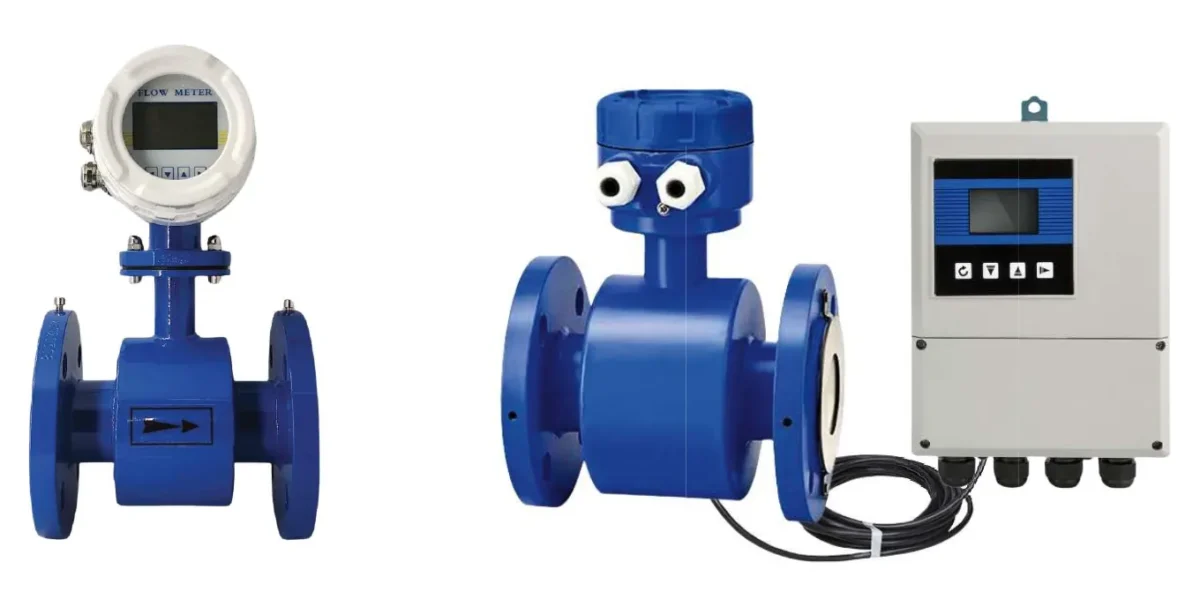
Electromagnetic Flow Meters
Electromagnetic Flow Meter for ETP & Corrosive Effluent
Mag flow meter for effluent, acids and alkalis with PTFE, FEP or PFA lining and Hastelloy, titanium, tantalum or platinum electrodes. DN10–DN2800, 4–20 mA, RS485, HART.
- PTFE, FEP or PFA lining up to 180 °C
- Hastelloy B/C, titanium, tantalum or platinum electrodes
- Forward and reverse flow
- Ex-proof version available
- 4–20 mA, pulse, RS485, HART
Electromagnetic Flow Meter for ETP & Corrosive Effluent specifications
| Size | DN10 – DN2800 |
|---|---|
| Medium | Conductive liquid, slurry |
| Medium temperature | E grade ≤ 60 °C; H grade ≤ 180 °C |
| Minimum conductivity | ≥ 5 µS/cm |
| Accuracy | ±0.25% or ±0.5% |
| Repeatability | ±0.1% / ±0.17% |
| Rated pressure | 0.6, 1.0, 1.6, 2.5, 4.0, 6.4 MPa (or as specified) |
| Display | Flow rate, totaliser, velocity, flow rate ratio |
| Signal output | 4–20 mA, pulse, RS485, HART |
| Power supply | AC 85–265 V; DC 18–38 V |
| Converter type | Integral or remote |
| Protection | IP65 / IP68 |
| Explosion proof | Ex de ib mb IIC T3–T6 |
| Flow velocity | 0.05–12 m/s (0.1–15 m/s on request) |
| Liner | CR (rubber) / F4 (PTFE) / F46 (FEP) / PFA |
| Flow direction | Forward and reverse |
| Electrode material | 316L, Pt, Ta, Ti, Hastelloy B, Hastelloy C, WC |
| Number of electrodes | 3–6 |
| Flange material | SS / CS |
| Alarm (normally open) | Empty pipe, excitation, upper/lower limit |
| Ambient | −30 to +60 °C, humidity < 90% |
| Protocol | RS485 / HART |
Industrial effluent often contains acids, alkalis, solvents and salts that would attack a standard flow meter. This ETP configuration pairs a chemically inert fluoropolymer lining with an electrode material chosen for your specific effluent, so the meter keeps reading accurately for years.
How to choose the lining material
| Lining | Symbol | Performance | Temperature | Typical use |
|---|---|---|---|---|
| Rubber | CR | Wear resistant; handles average concentrations of acid, alkali and salt solutions | ≤ 70 °C | Tap water, industrial water, sea water |
| PTFE | PTFE (F4) | Chemically stable; resists boiling hydrochloric acid, sulphuric acid, aqua regia and concentrated alkali | ≤ 150 °C | Corrosive acids, salts and solutions |
| Fluorinated ethylene propylene | F46 / FEP | Chemical resistance equivalent to F4 with higher tensile strength | ≤ 180 °C | Corrosive acid and salt solutions, negative pressure |
| Polyurethane | PU | Excellent wear resistance; not suitable for acids | ≤ 70 °C | Slurry, pulp and other abrasive media |
How to choose the electrode material
| Electrode | Suitable for | Not suitable for |
|---|---|---|
| 316L | Domestic water, industrial water, raw water, city sewage, weakly corrosive acid, alkali and salt solutions | Strong acids and alkalis |
| Hastelloy B | Non-oxidising acids below 10%, sodium hydroxide below 50%, ammonium hydroxide at all concentrations, phosphoric and organic acids | Nitric acid |
| Hastelloy C | Mixed acids (e.g. chromic + sulphuric), oxidising salts such as sea water containing Cu⁺⁺⁺ and Fe⁺⁺⁺ | Hydrochloric acid |
| Titanium | Salts (sodium, potassium, chloride, ammonium salts, sodium hypochlorite), potassium hydroxide below 50%, ammonium and barium hydroxide | Hydrochloric, sulphuric, phosphoric, hydrofluoric and other reducing acids |
| Tantalum | Hydrochloric acid below 40%, dilute and concentrated sulphuric acid (not oleum), chlorine dioxide, ferric chloride, hypochlorous acid, sodium chloride, lead acetate, nitric acid | Alkalis, hydrofluoric acid |
| Platinum | Almost all acid, alkali and salt solutions, including fuming sulphuric and fuming nitric acid | Aqua regia, ammonium salts |
Flow range by line size
| Size | Flow range (m³/h) | Accuracy range (m³/h) |
|---|---|---|
| DN 10 | 0.014–3.39 | 0.08–2.82 |
| DN 15 | 0.03–7.63 | 0.19–6.35 |
| DN 20 | 0.06–13.56 | 0.33–11.34 |
| DN 25 | 0.09–21.19 | 0.52–17.66 |
| DN 32 | 0.14–34.72 | 0.86–29.93 |
| DN 40 | 0.23–54.25 | 1.35–45.21 |
| DN 50 | 0.35–84.78 | 2.12–70.65 |
| DN 65 | 0.6–143 | 3.58–119 |
| DN 80 | 0.90–217 | 5.43–180 |
| DN 100 | 1.41–339 | 8.48–282 |
| DN 125 | 2.21–529 | 13.25–441 |
| DN 150 | 3.18–763 | 19.08–635 |
| DN 200 | 5.65–1356 | 33.91–1130 |
| DN 250 | 8.83–2119 | 52.99–1766 |
| DN 300 | 12.7–3052 | 76–2543 |
| DN 350 | 17.3–4154 | 103–3461 |
| DN 400 | 22.6–5425 | 135.5–4521 |
| DN 450 | 28.6–6867 | 171–5722 |
| DN 500 | 35.3–8478 | 211–7065 |
| DN 600 | 51–12208 | 305–10173 |
| DN 700 | 69–16616 | 415–13847 |
| DN 800 | 90–21703 | 542–18086 |
| DN 900 | 114–27468 | 686–22890 |
| DN 1000 | 141–33912 | 847–28260 |
| DN 1200 | 203–48833 | 1221–40694 |
| DN 1400 | 277–66467 | 1662–55389 |
| DN 1600 | 361–86814 | 2171–72345 |
| DN 1800 | 457–109874 | 2747–91562 |
Typical applications
- ETP inlet, equalisation and final outlet
- Chemical, pharma and dye-house effluent
- Acid and alkali dosing and transfer
- Electroplating and pickling lines
- Abrasive slurry (with PU lining)
Not sure which combination fits? Send us the effluent composition, temperature and line size and we will recommend the lining and electrode.
More Electromagnetic Flow Meters
-
 Electromagnetic Flow Meter for STP & General Water
Magnetic flow meter for sewage, raw water and treated water, DN10–DN2800, ±0.25%/±0.5% accuracy, integral or remote converter, 4–20…
Electromagnetic Flow Meter for STP & General Water
Magnetic flow meter for sewage, raw water and treated water, DN10–DN2800, ±0.25%/±0.5% accuracy, integral or remote converter, 4–20…
-
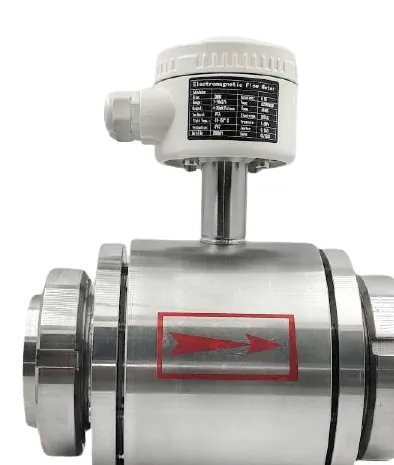 Sanitary Electromagnetic Flow Meter for Milk & Beverages
Hygienic stainless steel magnetic flow meter for milk, juice, beverages and injection liquids, with sanitary clamp connections suitable…
Sanitary Electromagnetic Flow Meter for Milk & Beverages
Hygienic stainless steel magnetic flow meter for milk, juice, beverages and injection liquids, with sanitary clamp connections suitable…
Get a quote for the Electromagnetic Flow Meter for ETP & Corrosive Effluent
Tell us the quantity, application and any options you need. We reply within one working day.